

linspace可以用来实现相同间隔的采样;
numpy.linspace(start,stop,num=50,endpoint=True,retstep=False, dtype=None)
返回num均匀分布的样本,在[start, stop]。
Parameters(参数):
start : scalar(标量) The starting value of the sequence(序列的起始点).
stop : scalar 序列的结束点,除非endpoint被设置为False,在这种情况下, the sequence consists of all but the last of num + 1 evenly spaced samples(该序列包括所有除了最后的num+1上均匀分布的样本(感觉这样翻译有点坑)), 以致于stop被排除.当endpoint is False的时候注意步长的大小(下面有例子).
num : int, optional(可选), 生成的样本数,默认是50。必须是非负。
endpoint : bool, optional, 如果是真,则一定包括stop,如果为False,一定不会有stop
retstep : bool, optional If True, return (samples, step), where step is the spacing between
samples.(看例子)
dtype : dtype, optional The type of the output array. If dtype is not given, infer the data type from the other input arguments(推断这个输入用例从其他的输入中). New in version 1.9.0.
Returns:
samples : ndarray
There are num equally spaced samples in the closed
interval [start, stop] or the half-open
interval [start, stop) (depending on whether endpoint is True or False).
step : float(只有当retstep设置为真的时候才会存在)
Only returned if retstep is True
Size of spacing between samples.
当endpoint被设置为False的时候
import numpy as np
np.linspace(1, 10, 10)
array([ 1., 2., 3., 4., 5., 6., 7., 8., 9., 10.])
np.linspace(1, 10, 10, endpoint = False)
array([ 1. , 1.9, 2.8, 3.7, 4.6, 5.5, 6.4, 7.3, 8.2, 9.1])
In [4]: np.linspace(1, 10, 10, endpoint = False, retstep= True)
Out[4]: (array([ 1. , 1.9, 2.8, 3.7, 4.6, 5.5, 6.4, 7.3, 8.2, 9.1]), 0.9)
官网的例子Examples
>>> np.linspace(2.0, 3.0, num=5)
 array([ 2. , 2.25, 2.5 , 2.75, 3. ])
>>> np.linspace(2.0, 3.0, num=5, endpoint=False)
 array([ 2. , 2.2, 2.4, 2.6, 2.8])
>>> np.linspace(2.0, 3.0, num=5, retstep=True)
 (array([ 2. , 2.25, 2.5 , 2.75, 3. ]), 0.25)
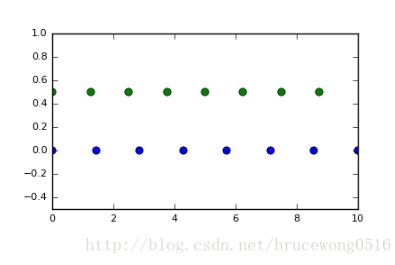
Graphical illustration:
>>> import matplotlib.pyplot as plt
>>> N = 8
>>> y = np.zeros(N)
>>> x1 = np.linspace(0, 10, N, endpoint=True)
>>> x2 = np.linspace(0, 10, N, endpoint=False)
>>> plt.plot(x1, y, 'o')
[<matplotlib.lines.Line2D object at 0x...>]
>>> plt.plot(x2, y + 0.5, 'o')
[<matplotlib.lines.Line2D object at 0x...>]
>>> plt.ylim([-0.5, 1])
(-0.5, 1)
>>> plt.show()
以上这篇python numpy库linspace相同间隔采样的实现就是小编分享给大家的全部内容了,希望能给大家一个参考,也希望大家多多支持脚本之家。


