下面是我统计的几种方案:
第一种方案(递归式):
简单的表结构为:
CategoryID int(4),
CategoryName nvarchar(50),
ParentID int(4),
Depth int(4)
这样根据ParentID一级级的运用递归找他的上级目录。
还有可以为了方便添加CategoryLeft,CategoryRight保存他的上级目录或下级目录
第二种方案: 设置一个varchar类型的CategoryPath字段来保存目录的完整路径,将父目录id用符号分隔开来。比如:1,5,8,10
第三种方案:
每级分类递增两位数字的方法
示例:
一级分类:01,02,03,04...
二级分类:0101,0102,0103,0104...
三级分类:010101,010102,010103...
分析一下,其实第三种方案并不能真正意义上做无限级的分类,而第二种方案,虽然比较容易得到各上级及下级的分类信息。但,添加和转移分类的时候操作将很麻烦。
而且,也完全违反了数据库设计范式。
其实我也一直在用第二种方案的。为了查找方便,我有时都在新闻表里加上CategoryID和CategoryPath
而我今天要说的算法其实是第二种方案的改进版,一般做分类都是使用一个表格来保存分类信息。
而我这里,要新建两个表格,一个表格是保存分类信息表,一个保存分类关系表。
表结构如下:
表1:tomi_Category
CategoryID int(4), '编号
CategoryName nvarchar(50), '分类名称
Depth int(4), '深度
表2:tomi_CategoryBind
CategoryID int(4),
BindCategoryID int(4),
Depth int(4),
添加,编辑,删除操作有点麻烦。。我是直接用存储过程的。。不知道大家能看得懂不。。哈哈。
1、添加分类(Category_Add)
CREATE proc [dbo].[Category_Add]
@CategoryName nvarchar(50),
@BindCategoryID int,
@CategoryID int output
as
declare @Success bit
set @Success=1
--生成不重复的CategoryID
declare @i bit
set @i=0
while @i=0
begin
set @CategoryID=LEFT(10000000 + CONVERT(bigint, ABS(CHECKSUM(NEWID()))), 8)
if(not exists(select CategoryID from tomi_Category where CategoryID=@CategoryID))
set @i=1
end
--得到depth
declare @depth int
set @depth=0
select @depth=depth from tomi_Category where CategoryID=@BindCategoryID
set @depth=@depth+1
--插入
BEGIN TRAN
insert into tomi_Category(categoryID,CategoryName,Depth) values(@CategoryID,@CategoryName,@Depth)
if(@@ERROR<>0)
BEGIN
ROLLBACK TRAN
set @Success=0
END
insert into tomi_CategoryBind(CategoryID,BindCategoryID,Depth) values(@CategoryID,@CategoryID,@Depth)
if(@@ERROR<>0)
BEGIN
ROLLBACK TRAN
set @Success=0
END
insert into tomi_CategoryBind(CategoryID,BindCategoryID,Depth) select @CategoryID,BindCategoryID,Depth from tomi_CategoryBind where CategoryID=@BindCategoryID
if(@@ERROR<>0)
BEGIN
ROLLBACK TRAN
set @Success=0
END
COMMIT TRAN
print @CategoryID
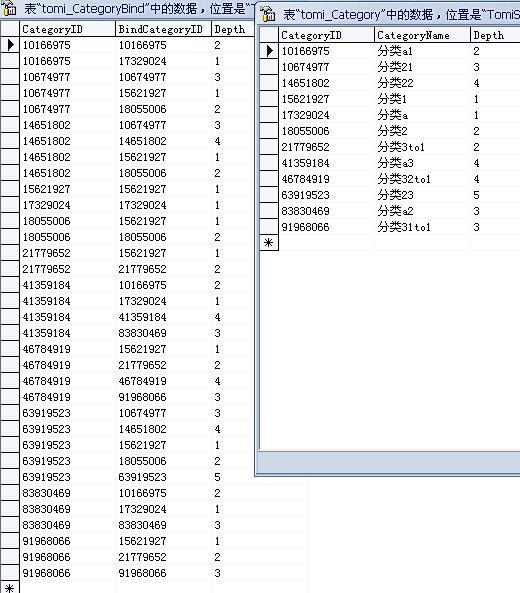
每个分类在tomi_CategoryBind有完整的目录结构。。一个分类在tomi_CategoryBind的记录数等于他在tomi_Category的depth值。
图片:
 2、编辑修改分类(Category_Edit)
CREATE proc [dbo].[Category_Edit]
@CategoryID int,
@CategoryName nvarchar(50),
@BindCategoryID int
as
--更新
BEGIN TRAN
update tomi_Category set CategoryName=@CategoryName where CategoryID=@CategoryID
IF @@ERROR<>0
BEGIN
ROLLBACK TRAN
return 0
END
COMMIT TRAN
--检测是否更改了上级目录
declare @is bit
set @is=0
if(exists(select CategoryID from tomi_CategoryBind where CategoryID=@CategoryID and BindCategoryID=@BindCategoryID and Depth=(select Depth-1 from tomi_Category where CategoryID=@CategoryID)))
set @is=1
print @is
--更改了深度
if(@is=0)
BEGIN
--得到上级目录的depth
declare @depth int
set @depth=0
select @depth=depth from tomi_Category where CategoryID=@BindCategoryID
set @depth=@depth+1
--print @depth
--更改子目录
declare @i int
declare @sCategoryID int
declare @sBindCategoryID int
declare @tCategoryIDList Table
(
CategoryID int,
FlagID tinyint
)
insert @tCategoryIDList select c.CategoryID,0 from tomi_Category c left join tomi_CategoryBind b on c.CategoryID=b.CategoryID where b.BindCategoryID=@CategoryID order by c.Depth
set @i=1
set @sBindCategoryID=@BindCategoryID
declare @errs int
set @errs=0
BEGIN TRAN
while(@i>=1)
BEGIN
select @sCategoryID=0
select Top 1 @sCategoryID=CategoryID from @tCategoryIDList where FlagID=0
set @i=@@RowCount
--print @sCategoryID
if @sCategoryID>0
BEGIN
--删除,更新
delete from tomi_CategoryBind where CategoryID=@sCategoryID
set @errs=@errs+@@error
update tomi_Category set depth=@depth where CategoryID=@sCategoryID
set @errs=@errs+@@error
--插入
insert into tomi_CategoryBind(CategoryID,BindCategoryID,Depth) values(@sCategoryID,@sCategoryID,@Depth)
set @errs=@errs+@@error
insert into tomi_CategoryBind(CategoryID,BindCategoryID,Depth) select @sCategoryID,BindCategoryID,Depth from tomi_CategoryBind where CategoryID=@sBindCategoryID
set @errs=@errs+@@error
set @sBindCategoryID=@sCategoryID
set @Depth=@Depth+1
--print @sCategoryID
--print @sBindCategoryID
--print @Depth
--print '--'
END
update @tCategoryIDList set FlagID=1 where CategoryID=@sCategoryID
END
if(@errs>0)
BEGIN
ROLLBACK TRAN
return 0
END
else
COMMIT TRAN
END
3、删除分类(Category_Del) 会直接删除子分类
create proc Category_Del
@CategoryID int
as
BEGIN TRAN
delete from tomi_Category where CategoryID in (select CategoryID from tomi_CategoryBind where CategoryID=@CategoryID or BindCategoryID=@CategoryID)
if(@@ERROR<>0)
BEGIN
ROLLBACK TRAN
return 0
END
delete from tomi_CategoryBind where CategoryID in (select CategoryID from tomi_CategoryBind where CategoryID=@CategoryID or BindCategoryID=@CategoryID)
if(@@ERROR<>0)
BEGIN
ROLLBACK TRAN
return 0
END
COMMIT TRAN
4、分类列表,显示分类(Category_List)
CREATE proc Category_List
as
select c.* from tomi_Category c left join tomi_CategoryBind b on c.CategoryID=b.CategoryID where b.Depth=1 order by b.BindCategoryID,c.Depth
GO
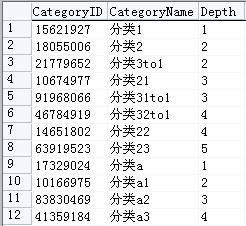
exec Category_List 可以直接让分类等级查询出来。而且显示全部的话,一次查询即可,只需判断depth就行。
图片:
 5、上级子分类列表 (Category_upTree)
Create Proc Category_UpTree
@CategoryID int
as
select c.* from tomi_Category c left join tomi_CategoryBind b on c.CategoryID=b.BindCategoryID where b.CategoryID=@CategoryID order by c.Depth
GO
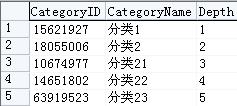
exec Category_UpTree 63919523 这样就可以得到一个分类的完整子目录集,方便吧,只要一条sql.
图片:
 6、下级子分类列表(Category_downTree)
Create Proc Category_DownTree
@CategoryID int
as
select c.* from tomi_Category c left join tomi_CategoryBind b on c.CategoryID=b.CategoryID where b.BindCategoryID=@CategoryID order by c.Depth
GO
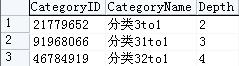
exec Category_DownTree 21779652 这样可以得到一个分类完整下级目录。比如得到某个分类和其分类的子分类下的所有产品用这个就好。。方便,一条sql.
图片:
以上是初稿,只是随意的测试了几次。。。有错误的,还请大家指出。。
呵呵。转载请注明链接,博客园首发,多谢。
作者:TomiWong
时间:2010.07.18


