

前言
在applicationContext.xml中配置完bean之后,Bean的声明周期状态有哪些。生命周期的各个阶段可以做什么。在applicationContext.xml配置bean的作用域有哪些。其中各个作用域代表的是什么。适用于什么情况。这篇文章做一个记录。
生命周期
初始化
可以直接查看图片,图片来自Spring Bean Life Cycle

从上图看出,Bean初始化完成包括9个步骤。其中一些步骤包括接口的实现,其中包括BeanNameAware接口,BeanFactoryAware接口。ApplicationContextAware接口。BeanPostProcessor接口,InitializingBean接口。那么这些接口在整个生命周期阶段都起到什么作用?后面我们一一介绍。
实例化前
当Bean全部属性设置完毕后,往往需要执行一些特定的行为,Spring提供了两种方式来实现此功能:
指定初始化方法
如下:
package com.model;
public class InitBean {
 public static final String NAME = "mark";
 public static final int AGE = 20;

 public InitBean() {
 // TODO Auto-generated constructor stub
 System.out.println("执行构造方法");
 }

 public String name;
 public int age ;
 public String getName() {
 return name;
 }
 public void setName(String name) {
 this.name = name;
 }
 public int getAge() {
 return age;
 }
 public void setAge(int age) {
 this.age = age;
 }

 public void init(){
 System.out.println("调用init方法进行成员变量的初始化");
 this.name = NAME;
 this.age = AGE;
 System.out.println("初始化完成");
 }
}
编写加载器
package com.model;
import org.springframework.context.ApplicationContext;
import org.springframework.context.support.ClassPathXmlApplicationContext;
import com.service.UserServiceImpl;
public class Main {
 public static void main(String[] args) {
 ApplicationContext context = new ClassPathXmlApplicationContext("initbean.xml");
 InitBean bean = (InitBean) context.getBean("init");
 }
}
配置Bean
注意init-method参数
<?xml version="1.0" encoding="UTF-8"?>
<beans xmlns="http://www.springframework.org/schema/beans"
 xmlns:xsi="http://www.w3.org/2001/XMLSchema-instance"
 xmlns:p="http://www.springframework.org/schema/p"
 xmlns:aop="http://www.springframework.org/schema/aop"
 xsi:schemaLocation="http://www.springframework.org/schema/beans http://www.springframework.org/schema/beans/spring-beans.xsd">
 <bean id="init" class="com.model.InitBean" init-method="init"/>
</beans>
执行结果

实现InitializingBean接口
实现InitializingBean接口会实现afterPropertiesSet方法,这个方法会自动调用。但是这个方式是侵入性的。一般情况下,不建议使用。
实现afterPropertiesSet方法
package com.model;
import org.springframework.beans.factory.InitializingBean;
public class InitBean implements InitializingBean {
 public static final String NAME = "mark";
 public static final int AGE = 20;

 public InitBean() {
 // TODO Auto-generated constructor stub
 System.out.println("执行构造方法");
 }

 public String name;
 public int age ;
 public String getName() {
 return name;
 }
 public void setName(String name) {
 this.name = name;
 }
 public int getAge() {
 return age;
 }
 public void setAge(int age) {
 this.age = age;
 }

 public void init(){
 System.out.println("调用init方法进行成员变量的初始化");
 this.name = NAME;
 this.age = AGE;
 System.out.println("初始化完成");
 }
 @Override
 public void afterPropertiesSet() throws Exception {
 // TODO Auto-generated method stub
 System.out.println("调用init方法进行成员变量的初始化");
 this.name = NAME;
 this.age = AGE;
 System.out.println("初始化完成");
 }
}
配置xml
<?xml version="1.0" encoding="UTF-8"?>
<beans xmlns="http://www.springframework.org/schema/beans"
 xmlns:xsi="http://www.w3.org/2001/XMLSchema-instance"
 xmlns:p="http://www.springframework.org/schema/p"
 xmlns:aop="http://www.springframework.org/schema/aop"
 xsi:schemaLocation="http://www.springframework.org/schema/beans http://www.springframework.org/schema/beans/spring-beans.xsd">
 <!-- <bean id="init" class="com.model.InitBean" init-method="init"/> -->
 <bean id="init" class="com.model.InitBean" init-method="init"/>
</beans>
结果:

销毁

同样,上图中表示来Bean销毁时候的过程。包括DisposableBean接口。
使用destroy-method方法
package com.model;
import org.springframework.beans.factory.InitializingBean;
public class InitBean implements InitializingBean {
 public static final String NAME = "mark";
 public static final int AGE = 20;

 public InitBean() {
 // TODO Auto-generated constructor stub
 System.out.println("执行构造方法");
 }

 public String name;
 public int age ;
 public String getName() {
 return name;
 }
 public void setName(String name) {
 this.name = name;
 }
 public int getAge() {
 return age;
 }
 public void setAge(int age) {
 this.age = age;
 }

 public void init(){
 System.out.println("调用init方法进行成员变量的初始化");
 this.name = NAME;
 this.age = AGE;
 System.out.println("初始化完成");
 }
 @Override
 public void afterPropertiesSet() throws Exception {
 // TODO Auto-generated method stub
 System.out.println("调用init方法进行成员变量的初始化");
 this.name = NAME;
 this.age = AGE;
 System.out.println("初始化完成");
 }

 public void close(){
 System.out.println("bean被销毁");
 }
}
配置Bean
<?xml version="1.0" encoding="UTF-8"?>
<beans xmlns="http://www.springframework.org/schema/beans"
 xmlns:xsi="http://www.w3.org/2001/XMLSchema-instance"
 xmlns:p="http://www.springframework.org/schema/p"
 xmlns:aop="http://www.springframework.org/schema/aop"
 xsi:schemaLocation="http://www.springframework.org/schema/beans http://www.springframework.org/schema/beans/spring-beans.xsd">
 <!-- <bean id="init" class="com.model.InitBean" init-method="init"/> -->
 <bean id="init" class="com.model.InitBean" destroy-method="close"/>
</beans>
配置加载器
package com.model;
import org.springframework.context.ApplicationContext;
import org.springframework.context.support.AbstractApplicationContext;
import org.springframework.context.support.ClassPathXmlApplicationContext;
import com.service.UserServiceImpl;
public class Main {
 public static void main(String[] args) {
 AbstractApplicationContext context = new ClassPathXmlApplicationContext("initbean.xml");
 context.registerShutdownHook();
 InitBean bean = (InitBean) context.getBean("init");
 }
}
结果:

实现DisposableBean接口
实现DisposableBean接口
package com.model;
import org.springframework.beans.factory.DisposableBean;
import org.springframework.beans.factory.InitializingBean;
public class InitBean implements InitializingBean,DisposableBean {
 public static final String NAME = "mark";
 public static final int AGE = 20;

 public InitBean() {
 // TODO Auto-generated constructor stub
 System.out.println("执行构造方法");
 }

 public String name;
 public int age ;
 public String getName() {
 return name;
 }
 public void setName(String name) {
 this.name = name;
 }
 public int getAge() {
 return age;
 }
 public void setAge(int age) {
 this.age = age;
 }

 public void init(){
 System.out.println("调用init方法进行成员变量的初始化");
 this.name = NAME;
 this.age = AGE;
 System.out.println("初始化完成");
 }
 @Override
 public void afterPropertiesSet() throws Exception {
 // TODO Auto-generated method stub
 System.out.println("调用init方法进行成员变量的初始化");
 this.name = NAME;
 this.age = AGE;
 System.out.println("初始化完成");
 }

 public void close(){
 System.out.println("bean被销毁");
 }
 @Override
 public void destroy() throws Exception {
 // TODO Auto-generated method stub
 System.out.println("bean被销毁完成");
 }
}
配置文件
<?xml version="1.0" encoding="UTF-8"?>
<beans xmlns="http://www.springframework.org/schema/beans"
 xmlns:xsi="http://www.w3.org/2001/XMLSchema-instance"
 xmlns:p="http://www.springframework.org/schema/p"
 xmlns:aop="http://www.springframework.org/schema/aop"
 xsi:schemaLocation="http://www.springframework.org/schema/beans http://www.springframework.org/schema/beans/spring-beans.xsd">
 <!-- <bean id="init" class="com.model.InitBean" init-method="init"/> -->
 <!-- <bean id="init" class="com.model.InitBean" destroy-method="close"/> -->
 <bean id="init" class="com.model.InitBean"/>
</beans>

Spring Bean的作用域
| 作用域 | 描述 |
| singleton | 该作用域将 bean 的定义的限制在每一个 Spring IoC 容器中的一个单一实例(默认)。 |
| prototype | 该作用域将单一 bean 的定义限制在任意数量的对象实例。 |
| request | 该作用域将 bean 的定义限制为 HTTP 请求。只在 web-aware Spring ApplicationContext 的上下文中有效。 |
| session | 该作用域将 bean 的定义限制为 HTTP 会话。 只在web-aware Spring ApplicationContext的上下文中有效。 |
| global-session | 该作用域将 bean 的定义限制为全局 HTTP 会话。只在 web-aware Spring ApplicationContext 的上下文中有效。 |
配置示例
<bean id="..." class="..." scope="singleton">
</bean>
使用方法注入协调作用域不同的Bean
正常情况下,如果singleton作用域依赖singleton作用域。即每次获取到的都是一样的对象。同理,prototype作用域依赖prototype作用域,每次获取到的都是新的对象。但是,如果singleton依赖prototype作用域,那么每次获取到的singleton中的prototype都是第一次创建的prototype。如何协调这种关系。保证每次获取到的都是正确的呢。
对于这种情况,Spring提供了lookup方法用来解决这种问题。
首先我们定义一个原型:
package com.model;
public class MyHelper {
 public void doSomethingHelpful() {

 }
}
然后通过接口注入:
package com.model;
public interface DemoBean {
 MyHelper getHelper();
 void somePeration();
}
配置一个单例:
package com.model;
/**
 * 测试类
 * @author kevin
 *
 */
public abstract class AbstractLookupDemo implements DemoBean {

 public abstract MyHelper getMyHelper();

 @Override
 public MyHelper getHelper() {
 // TODO Auto-generated method stub
 return getMyHelper();
 }

 @Override
 public void somePeration() {
 // TODO Auto-generated method stub

 }
}
配置文件:
<?xml version="1.0" encoding="UTF-8"?>
<beans xmlns="http://www.springframework.org/schema/beans"
  xmlns:xsi="http://www.w3.org/2001/XMLSchema-instance"
  xmlns:p="http://www.springframework.org/schema/p"
  xmlns:aop="http://www.springframework.org/schema/aop"
  xsi:schemaLocation="http://www.springframework.org/schema/beans http://www.springframework.org/schema/beans/spring-beans.xsd">
  <bean id="helper" class="com.model.MyHelper" scope="prototype"/>
  <bean id="standardLookupBean" class="com.model.StandardLookupDemo">
  <property name="myHelper" ref="helper"></property>
  </bean>
  <bean id = "abstractLookupBean" class="com.model.AbstractLookupDemo">
  <lookup-method name="getMyHelper" bean="helper"></lookup-method>
  </bean>
</beans>
加载配置文件:
package com.model;
import org.springframework.context.support.AbstractApplicationContext;
import org.springframework.context.support.ClassPathXmlApplicationContext;
import org.springframework.util.StopWatch;
public class Main {
 public static void main(String[] args) {

 AbstractApplicationContext context = new ClassPathXmlApplicationContext("lookBean.xml");
 context.registerShutdownHook();
 System.out.println("传递standardLookupBean");
 test(context, "standardLookupBean");
 System.out.println("传递AbstractLookupDemo");
 test(context, "abstractLookupBean");
 }

 public static void test(AbstractApplicationContext context,String beanName) {
 DemoBean bean = (DemoBean) context.getBean(beanName);
 MyHelper helper1 = bean.getHelper();
 MyHelper helper2 = bean.getHelper();
 System.out.println("测试"+beanName);
 System.out.println("两个helper是否相同?"+(helper1==helper2));
 StopWatch stopWatch = new StopWatch();
 stopWatch.start("lookupDemo");
 for (int i = 0; i < 10000; i++) {
 MyHelper helper = bean.getHelper();
 helper.doSomethingHelpful();
 }
 stopWatch.stop();
 System.out.println("获取10000次花费了"+stopWatch.getTotalTimeMillis()+"毫秒");
 }
}
结果:
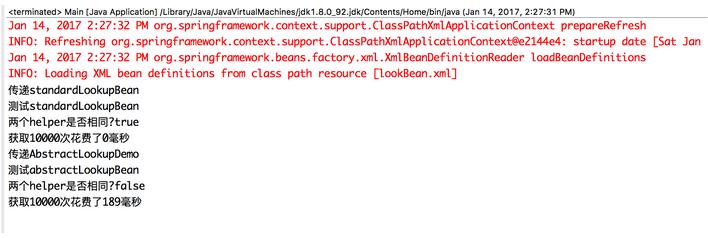
从上面的结果图看出,以前的方式生成的对象每次都是相同的。通过lookup方式注入每次是不同的。可以解决这种问题。但是有没有更简单的方式,感觉这种方式优点麻烦。
让Bean感知Spring容器
实现BeanNameAware,自定设置id值。
实现BeanFactoryAware,ApplicationContextAware 感知Spring容器。获取Spring容器。
Spring国际化支持
配置配置文件
<?xml version="1.0" encoding="UTF-8"?>
<beans xmlns="http://www.springframework.org/schema/beans"
  xmlns:xsi="http://www.w3.org/2001/XMLSchema-instance"
  xmlns:p="http://www.springframework.org/schema/p"
  xmlns:aop="http://www.springframework.org/schema/aop"
  xsi:schemaLocation="http://www.springframework.org/schema/beans http://www.springframework.org/schema/beans/spring-beans.xsd">
  <bean id="messageSource" class="org.springframework.context.support.ResourceBundleMessageSource">
  <property name="basenames">
   <list>
   <value>message</value>
   </list>
  </property>
  </bean>
</beans>
新建中文配置文件
message_zh_CN.properties:
hello=welcome,{0}
now=now is : {0}
新建英文配置文件
message_en_US.properties:
hello=\u4F60\u597D,{0}
now=\u73B0\u5728\u7684\u65F6\u95F4\u662F : {0}
加载配置文件
package com.model;
import java.util.Date;
import java.util.Locale;
import org.springframework.context.ApplicationContext;
import org.springframework.context.support.AbstractApplicationContext;
import org.springframework.context.support.ClassPathXmlApplicationContext;
import org.springframework.util.StopWatch;
public class Main {
 public static void main(String[] args) {
 ApplicationContext context = new ClassPathXmlApplicationContext("globalization.xml");
 String[] a = {"读者"};
 String hello = context.getMessage("hello",a, Locale.CHINA);
 Object[] b = {new Date()};
 String now = context.getMessage("now",b, Locale.CHINA);
 System.out.println(hello);
 System.out.println(now);
 hello = context.getMessage("hello",a, Locale.US);
 now = context.getMessage("now",b, Locale.US);
 System.out.println(hello);
 System.out.println(now);
 }
}
结果

好了,以上就是这篇文章的全部内容了,希望本文的内容对大家的学习或者工作能带来一定的帮助,如果有疑问大家可以留言交流,谢谢大家对脚本之家的支持。


