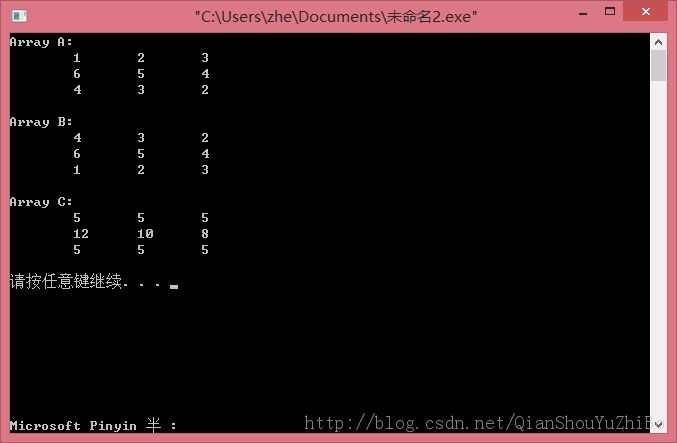
1.矩阵相加
两个同型矩阵做加法,就是对应的元素相加。
#include<iostream>
using namespace std;
int main(){
int a[3][3]={{1,2,3},{6,5,4},{4,3,2}};
int b[3][3]={{4,3,2},{6,5,4},{1,2,3}};
int c[3][3]={0,0,0,0,0,0,0,0,0};
int i,j;
cout<<"Array A:"<<endl;
for(i=0;i<3;i++){
for(j=0;j<3;j++){
c[i][j]+=a[i][j];//实现相加操作1
cout<<"\t"<<a[i][j];//输出矩阵A
}
cout<<endl;
}
cout<<endl;
cout<<"Array B:"<<endl;
for(i=0;i<3;i++){
for(j=0;j<3;j++){
c[i][j]+=b[i][j];//实现矩阵操作2
cout<<"\t"<<b[i][j];//输出矩阵B
}
cout<<endl;
}
cout<<endl;
cout<<"Array C:"<<endl;
for(i=0;i<3;i++){
for(j=0;j<3;j++){
cout<<"\t"<<c[i][j];//输出矩阵C
}
cout<<endl;
}
cout<<endl;
return 0;
}
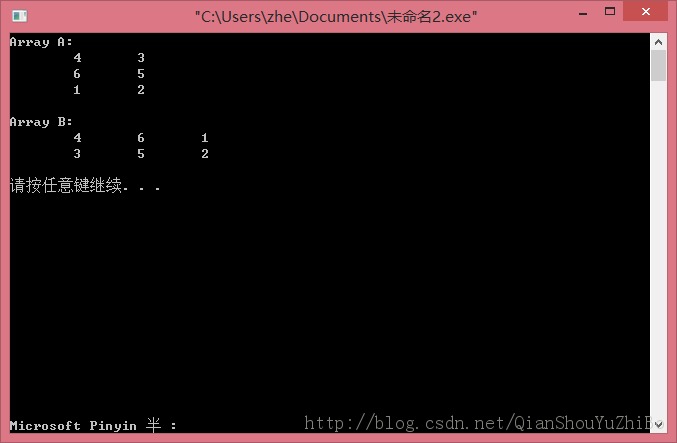
 2.实现矩阵的转置
#include<iostream>
using namespace std;
int main(){
int a[3][2]={{4,3},{6,5},{1,2}};
int b[2][3]={0,0,0,0,0,0};
int i,j;
cout<<"Array A:"<<endl;
for(i=0;i<3;i++){
for(j=0;j<2;j++){
cout<<"\t"<<a[i][j];//输出矩阵A
b[j][i]=a[i][j];//进行转置操作
}
cout<<endl;
}
cout<<endl;
cout<<"Array B:"<<endl;
for(i=0;i<2;i++){
for(j=0;j<3;j++){
cout<<"\t"<<b[i][j];
}
cout<<endl;
}
cout<<endl;
return 0;
}
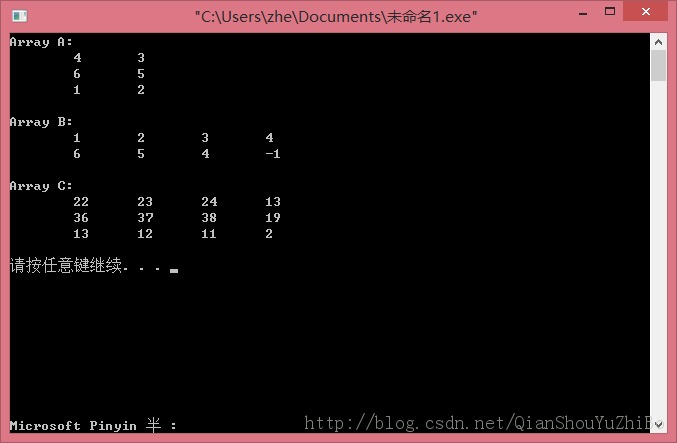
 3.实现矩阵的相乘
一个m行n列的矩阵可以和n列k行的矩阵相乘,得到一个m行k列的矩阵
#include<iostream>
using namespace std;
int main(){
int a[3][2]={{4,3},{6,5},{1,2}};
int b[2][3]={{1,2,3},{6,5,4}};
int c[3][3]={0,0,0,0,0,0,0,0,0};
int i,j,k,l;
cout<<"Array A:"<<endl;
for(i=0;i<3;i++){
for(j=0;j<2;j++){
cout<<"\t"<<a[i][j];//输出矩阵A
}
cout<<endl;
}
cout<<endl;
cout<<"Array B:"<<endl;
for(i=0;i<2;i++){
for(j=0;j<3;j++){
cout<<"\t"<<b[i][j];//输出矩阵B
}
cout<<endl;
}
cout<<endl;
cout<<"Array C:"<<endl;
for(i=0;i<3;i++){
for(j=0;j<3;j++){
for(k=0;k<2;k++){
c[i][j]+=a[i][k]*b[k][j];//实现相乘操作
}
cout<<"\t"<<c[i][j];//输出矩阵C
}
cout<<endl;
}
cout<<endl;
return 0;
}
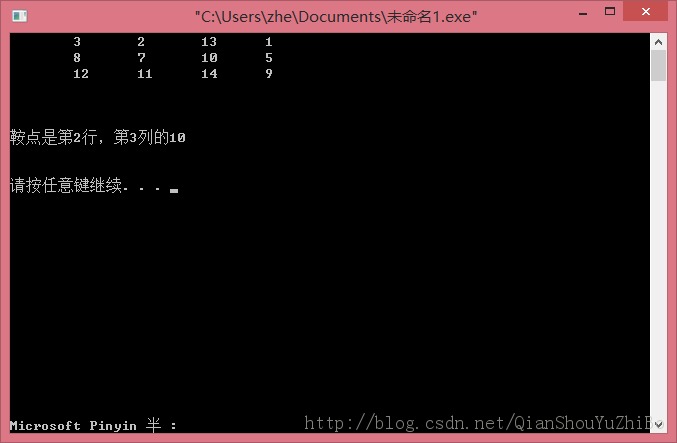
4.求矩阵中的鞍点
在矩阵中行中最大,列中最小的元素就是我们要求的鞍点
#include<iostream>
using namespace std;
int main(){
int a[3][4]={{3,2,13,1},{8,7,10,5},{12,11,14,9}};
int i,j,k,ad,q=0;
bool tag;
for(i=0;i<3;i++){
for(j=0;j<4;j++){
cout<<"\t"<<a[i][j];
}
cout<<endl;
}
cout<<endl;
for(i=0;i<3;i++){
ad=a[i][0];
tag=true;
for(j=1;j<4;j++){
if(ad<a[i][j]){
k=j;
}//先选出行中最大
}
for(j=0;j<3;j++){
if(a[i][k]>a[j][k]){
tag=false;
};//再选出列中最小
}
cout<<endl;
if(tag==true){
cout<<"鞍点是第"<<(i+1)<<"行,第"<<(k+1)<<"列的"<<a[i][k]<<endl;
q++;
}
}
if(q==0){
cout<<"没有一个鞍点~"<<endl;
}
cout<<endl;
return 0;
}