

需求
在4*4的图片中,比较外围黑色像素点和内圈黑色像素点个数的大小将图片分类
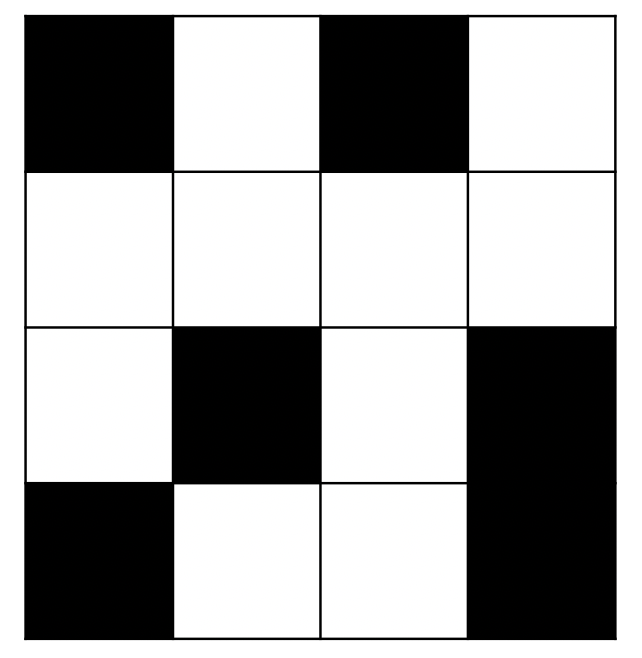
如上图图片外围黑色像素点5个大于内圈黑色像素点1个分为0类反之1类
想法
代码
import torch
import torchvision
import torchvision.transforms as transforms
import numpy as np
from PIL import Image
构造数据集
import csv
import collections
import os
import shutil

def buildDataset(root,dataType,dataSize):
  """构造数据集
  构造的图片存到root/{dataType}Data
  图片地址和标签的csv文件存到 root/{dataType}DataInfo.csv
  Args:
    root:str
      项目目录
    dataType:str
      'train'或者‘test'
    dataNum:int
      数据大小
  Returns:
  """
  dataInfo = []
  dataPath = f'{root}/{dataType}Data'
  if not os.path.exists(dataPath):
    os.makedirs(dataPath)
  else:
    shutil.rmtree(dataPath)
    os.mkdir(dataPath)

  for i in range(dataSize):
    # 创建0,1 数组
    imageArray=np.random.randint(0,2,(4,4))
    # 计算0,1数量得到标签
    allBlackNum = collections.Counter(imageArray.flatten())[0]
    innerBlackNum = collections.Counter(imageArray[1:3,1:3].flatten())[0]
    label = 0 if (allBlackNum-innerBlackNum)>innerBlackNum else 1
    # 将图片保存
    path = f'{dataPath}/{i}.jpg'
    dataInfo.append([path,label])
    im = Image.fromarray(np.uint8(imageArray*255))
    im = im.convert('1')
    im.save(path)
  # 将图片地址和标签存入csv文件
  filePath = f'{root}/{dataType}DataInfo.csv'
  with open(filePath, 'w') as f:
    writer = csv.writer(f)
    writer.writerows(dataInfo)
root=r'/Users/null/Documents/PythonProject/Classifier'
构造训练数据集
buildDataset(root,'train',20000)
构造测试数据集
buildDataset(root,'test',10000)
读取数据集
class MyDataset(torch.utils.data.Dataset):

  def __init__(self, root, datacsv, transform=None):
    super(MyDataset, self).__init__()
    with open(f'{root}/{datacsv}', 'r') as f:
      imgs = []
      # 读取csv信息到imgs列表
      for path,label in map(lambda line:line.rstrip().split(','),f):
        imgs.append((path, int(label)))
    self.imgs = imgs
    self.transform = transform if transform is not None else lambda x:x

  def __getitem__(self, index):
    path, label = self.imgs[index]
    img = self.transform(Image.open(path).convert('1'))
    return img, label

  def __len__(self):
    return len(self.imgs)
trainData=MyDataset(root = root,datacsv='trainDataInfo.csv', transform=transforms.ToTensor())
testData=MyDataset(root = root,datacsv='testDataInfo.csv', transform=transforms.ToTensor())
处理数据集使得数据集不偏斜
import itertools

def chooseData(dataset,scale):
  # 将类别为1的排序到前面
  dataset.imgs.sort(key=lambda x:x[1],reverse=True)
  # 获取类别1的数目 ,取scale倍的数组,得数据不那么偏斜
  trueNum =collections.Counter(itertools.chain.from_iterable(dataset.imgs))[1]
  end = min(trueNum*scale,len(dataset))
  dataset.imgs=dataset.imgs[:end]
scale = 4
chooseData(trainData,scale)
chooseData(testData,scale)
len(trainData),len(testData)
(2250, 1122)
import torch.utils.data as Data

# 超参数
batchSize = 50
lr = 0.1
numEpochs = 20

trainIter = Data.DataLoader(dataset=trainData, batch_size=batchSize, shuffle=True)
testIter = Data.DataLoader(dataset=testData, batch_size=batchSize)
定义模型
from torch import nn
from torch.autograd import Variable
from torch.nn import Module,Linear,Sequential,Conv2d,ReLU,ConstantPad2d
import torch.nn.functional as F
class Net(Module):
  def __init__(self):
    super(Net, self).__init__()

    self.cnnLayers = Sequential(
      # padding添加1层常数1,设定卷积核为2*2
      ConstantPad2d(1, 1),
      Conv2d(1, 1, kernel_size=2, stride=2,bias=True)
    )
    self.linearLayers = Sequential(
      Linear(9, 2)
    )

  def forward(self, x):
    x = self.cnnLayers(x)
    x = x.view(x.shape[0], -1)
    x = self.linearLayers(x)
    return x
class Net2(Module):
  def __init__(self):
    super(Net2, self).__init__()

    self.cnnLayers = Sequential(
      Conv2d(1, 1, kernel_size=1, stride=1,bias=True)
    )
    self.linearLayers = Sequential(
      ReLU(),
      Linear(16, 2)
    )

  def forward(self, x):
    x = self.cnnLayers(x)
    x = x.view(x.shape[0], -1)
    x = self.linearLayers(x)
    return x
定义损失函数
# 交叉熵损失函数
loss = nn.CrossEntropyLoss()
loss2 = nn.CrossEntropyLoss()
定义优化算法
net = Net()
optimizer = torch.optim.SGD(net.parameters(),lr = lr)
net2 = Net2()
optimizer2 = torch.optim.SGD(net2.parameters(),lr = lr)
训练模型
# 计算准确率
def evaluateAccuracy(dataIter, net):
  accSum, n = 0.0, 0
  with torch.no_grad():
    for X, y in dataIter:
      accSum += (net(X).argmax(dim=1) == y).float().sum().item()
      n += y.shape[0]
  return accSum / n
def train(net, trainIter, testIter, loss, numEpochs, batchSize,
       optimizer):
  for epoch in range(numEpochs):
    trainLossSum, trainAccSum, n = 0.0, 0.0, 0
    for X,y in trainIter:
      yHat = net(X)
      l = loss(yHat,y).sum()
      optimizer.zero_grad()
      l.backward()
      optimizer.step()
      # 计算训练准确度和loss
      trainLossSum += l.item()
      trainAccSum += (yHat.argmax(dim=1) == y).sum().item()
      n += y.shape[0]
    # 评估测试准确度
    testAcc = evaluateAccuracy(testIter, net)
    print('epoch {:d}, loss {:.4f}, train acc {:.3f}, test acc {:.3f}'.format(epoch + 1, trainLossSum / n, trainAccSum / n, testAcc))
Net模型训练
train(net, trainIter, testIter, loss, numEpochs, batchSize,optimizer)
epoch 1, loss 0.0128, train acc 0.667, test acc 0.667
epoch 2, loss 0.0118, train acc 0.683, test acc 0.760
epoch 3, loss 0.0104, train acc 0.742, test acc 0.807
epoch 4, loss 0.0093, train acc 0.769, test acc 0.772
epoch 5, loss 0.0085, train acc 0.797, test acc 0.745
epoch 6, loss 0.0084, train acc 0.798, test acc 0.807
epoch 7, loss 0.0082, train acc 0.804, test acc 0.816
epoch 8, loss 0.0078, train acc 0.816, test acc 0.812
epoch 9, loss 0.0077, train acc 0.818, test acc 0.817
epoch 10, loss 0.0074, train acc 0.824, test acc 0.826
epoch 11, loss 0.0072, train acc 0.836, test acc 0.819
epoch 12, loss 0.0075, train acc 0.823, test acc 0.829
epoch 13, loss 0.0071, train acc 0.839, test acc 0.797
epoch 14, loss 0.0067, train acc 0.849, test acc 0.824
epoch 15, loss 0.0069, train acc 0.848, test acc 0.843
epoch 16, loss 0.0064, train acc 0.864, test acc 0.851
epoch 17, loss 0.0062, train acc 0.867, test acc 0.780
epoch 18, loss 0.0060, train acc 0.871, test acc 0.864
epoch 19, loss 0.0057, train acc 0.881, test acc 0.890
epoch 20, loss 0.0055, train acc 0.885, test acc 0.897
Net2模型训练
# batchSize = 50
# lr = 0.1
# numEpochs = 15 下得出的结果
train(net2, trainIter, testIter, loss2, numEpochs, batchSize,optimizer2)

epoch 1, loss 0.0119, train acc 0.638, test acc 0.676
epoch 2, loss 0.0079, train acc 0.823, test acc 0.986
epoch 3, loss 0.0046, train acc 0.987, test acc 0.977
epoch 4, loss 0.0030, train acc 0.983, test acc 0.973
epoch 5, loss 0.0023, train acc 0.981, test acc 0.976
epoch 6, loss 0.0019, train acc 0.980, test acc 0.988
epoch 7, loss 0.0016, train acc 0.984, test acc 0.984
epoch 8, loss 0.0014, train acc 0.985, test acc 0.986
epoch 9, loss 0.0013, train acc 0.987, test acc 0.992
epoch 10, loss 0.0011, train acc 0.989, test acc 0.993
epoch 11, loss 0.0010, train acc 0.989, test acc 0.996
epoch 12, loss 0.0010, train acc 0.992, test acc 0.994
epoch 13, loss 0.0009, train acc 0.993, test acc 0.994
epoch 14, loss 0.0008, train acc 0.995, test acc 0.996
epoch 15, loss 0.0008, train acc 0.994, test acc 0.998
测试
test = torch.Tensor([[[[0,0,0,0],[0,1,1,0],[0,1,1,0],[0,0,0,0]]],
[[[1,1,1,1],[1,0,0,1],[1,0,0,1],[1,1,1,1]]],
[[[0,1,0,1],[1,0,0,1],[1,0,0,1],[0,0,0,1]]],
[[[0,1,1,1],[1,0,0,1],[1,0,0,1],[0,0,0,1]]],
[[[0,0,1,1],[1,0,0,1],[1,0,0,1],[1,0,1,0]]],
[[[0,0,1,0],[0,1,0,1],[0,0,1,1],[1,0,1,0]]],
[[[1,1,1,0],[1,0,0,1],[1,0,1,1],[1,0,1,1]]]
])
target=torch.Tensor([0,1,0,1,1,0,1])
test
tensor([[[[0., 0., 0., 0.],
[0., 1., 1., 0.],
[0., 1., 1., 0.],
[0., 0., 0., 0.]]],
[[[1., 1., 1., 1.],
[1., 0., 0., 1.],
[1., 0., 0., 1.],
[1., 1., 1., 1.]]],
[[[0., 1., 0., 1.],
[1., 0., 0., 1.],
[1., 0., 0., 1.],
[0., 0., 0., 1.]]],
[[[0., 1., 1., 1.],
[1., 0., 0., 1.],
[1., 0., 0., 1.],
[0., 0., 0., 1.]]],
[[[0., 0., 1., 1.],
[1., 0., 0., 1.],
[1., 0., 0., 1.],
[1., 0., 1., 0.]]],
[[[0., 0., 1., 0.],
[0., 1., 0., 1.],
[0., 0., 1., 1.],
[1., 0., 1., 0.]]],
[[[1., 1., 1., 0.],
[1., 0., 0., 1.],
[1., 0., 1., 1.],
[1., 0., 1., 1.]]]])
with torch.no_grad():
output = net(test)
output2 = net2(test)
predictions =output.argmax(dim=1)
predictions2 =output2.argmax(dim=1)
# 比较结果
print(f'Net测试结果{predictions.eq(target)}')
print(f'Net2测试结果{predictions2.eq(target)}')
Net测试结果tensor([ True, True, False, True, True, True, True])
Net2测试结果tensor([False, True, False, True, True, False, True])


