

JavaBean四个作用域范围的详解
一 说明
使用useBeans的scope属性可以用来指定javabean的作用范围。
二 四个作用范围

三 代码
1、login.jsp
<%@ page language="java" import="java.util.*" contentType="text/html; charset=utf-8" %>
<%
String path = request.getContextPath();
String basePath = request.getScheme()+"://"+request.getServerName()+":"+request.getServerPort()+path+"/";
%>

<!DOCTYPE HTML PUBLIC "-//W3C//DTD HTML 4.01 Transitional//EN">
<html>
 <head>
  <base href="<%=basePath%>" rel="external nofollow" rel="external nofollow" rel="external nofollow" >

  <title>My JSP 'login.jsp' starting page</title>

    <meta http-equiv="pragma" content="no-cache">
    <meta http-equiv="cache-control" content="no-cache">
    <meta http-equiv="expires" content="0">
    <meta http-equiv="keywords" content="keyword1,keyword2,keyword3">
    <meta http-equiv="description" content="This is my page">
    <!--
    <link rel="stylesheet" type="text/css" href="styles.css" rel="external nofollow" rel="external nofollow" rel="external nofollow" >
    -->

 </head>

 <body>
  <h1>系统登录</h1>
  <hr>
  <form name="loginForm" action="dologin.jsp?mypass=999999" method="post">
   <table>
    <tr>
     <td>用户名:</td>
     <td><input type="text" name="username" value=""/></td>
    </tr>
    <tr>
     <td>密码:</td>
     <td><input type="password" name="password" value=""/></td>
    </tr>
    <tr>
     <td colspan="2" align="center"><input type="submit" value="登录"/></td>

    </tr>
   </table>
  </form>
 </body>
</html>
2、dologin.jsp
<%@ page language="java" import="java.util.*" contentType="text/html; charset=utf-8"%>
<%
String path = request.getContextPath();
String basePath = request.getScheme()+"://"+request.getServerName()+":"+request.getServerPort()+path+"/";
%>

<!DOCTYPE HTML PUBLIC "-//W3C//DTD HTML 4.01 Transitional//EN">
<html>
 <head>
  <base href="<%=basePath%>" rel="external nofollow" rel="external nofollow" rel="external nofollow" >

  <title>My JSP 'dologin.jsp' starting page</title>

    <meta http-equiv="pragma" content="no-cache">
    <meta http-equiv="cache-control" content="no-cache">
    <meta http-equiv="expires" content="0">
    <meta http-equiv="keywords" content="keyword1,keyword2,keyword3">
    <meta http-equiv="description" content="This is my page">
    <!--
    <link rel="stylesheet" type="text/css" href="styles.css" rel="external nofollow" rel="external nofollow" rel="external nofollow" >
    -->

 </head>

 <body>
  <jsp:useBean id="myUsers" class="com.po.Users" scope="page"/>
  <h1>setProperty动作元素</h1>
  <hr>
  <!--根据表单自动匹配所有的属性 -->
  <%--
  <jsp:setProperty name="myUsers" property="*"/>
  --%>
  <!--根据表单匹配所有部分的属性 -->
  <%--
  <jsp:setProperty name="myUsers" property="username"/>
  --%>
  <!--根表单无关,通过手工赋值给属性 -->
  <%--
  <jsp:setProperty name="myUsers" property="username" value="lisi"/>
  <jsp:setProperty name="myUsers" property="password" value="888888"/>
  --%>
  <!--通过URL传参数给属性赋值 -->
  <jsp:setProperty name="myUsers" property="username"/>
  <jsp:setProperty name="myUsers" property="password" param="mypass"/>
  <!-- 使用传统的表达式方式来获取用户名和密码 -->
  <%--
    用户名:<%=myUsers.getUsername() %><br>
    密码:<%=myUsers.getPassword() %><br>
  --%>
  <!-- 使用getProperty方式来获取用户名和密码 -->
   用户名:<jsp:getProperty name="myUsers" property="username"/> <br>
   密码:<jsp:getProperty name="myUsers" property="password"/><br>
  <br>
  <br>

   <a href="testScope.jsp" rel="external nofollow" >测试javabean的四个作用域范围</a>

   <%
     request.getRequestDispatcher("testScope.jsp").forward(request, response);
   %>

 </body>
</html>
3、testScope.jsp
<%@ page language="java" import="java.util.*"
    contentType="text/html; charset=utf-8"%>
<%@ page import="com.po.Users"%>
<%
    String path = request.getContextPath();
    String basePath = request.getScheme() + "://"
            + request.getServerName() + ":" + request.getServerPort()
            + path + "/";
%>

<!DOCTYPE HTML PUBLIC "-//W3C//DTD HTML 4.01 Transitional//EN">
<html>
<head>
<base href="<%=basePath%>" rel="external nofollow" rel="external nofollow" rel="external nofollow" >

<title>My JSP 'testScope.jsp' starting page</title>

<meta http-equiv="pragma" content="no-cache">
<meta http-equiv="cache-control" content="no-cache">
<meta http-equiv="expires" content="0">
<meta http-equiv="keywords" content="keyword1,keyword2,keyword3">
<meta http-equiv="description" content="This is my page">
<!--
    <link rel="stylesheet" type="text/css" href="styles.css" rel="external nofollow" rel="external nofollow" rel="external nofollow" >
    -->

</head>

<body>
    <h1>Javabean的四个作用域范围</h1>
    <hr>
    <jsp:useBean id="myUsers" class="com.po.Users" scope="page" />
    用户名:<jsp:getProperty name="myUsers" property="username" /><br> 密码:<jsp:getProperty
        name="myUsers" property="password" /><br>
    <!-- 使用内置对象获取用户名和密码 -->
    <hr>
    <%--
    用户名:<%=((Users)application.getAttribute("myUsers")).getUsername()%><br>
    密码:<%=((Users)application.getAttribute("myUsers")).getPassword() %><br>
  --%>
    <%--
    用户名:<%=((Users)session.getAttribute("myUsers")).getUsername()%><br>
    密码:<%=((Users)session.getAttribute("myUsers")).getPassword() %><br>
  --%>
    <%--
    用户名:<%=((Users)request.getAttribute("myUsers")).getUsername()%><br>
    密码:<%=((Users)request.getAttribute("myUsers")).getPassword() %><br>
  --%>
    <%
        String username = "";
        String password = "";
        if (pageContext.getAttribute("myUsers") != null) {
            username = ((Users) pageContext.getAttribute("myUsers"))
                    .getUsername();
            password = ((Users) pageContext.getAttribute("myUsers"))
                    .getPassword();
        }
    %>

    用户名:<%=username%><br> 密码:<%=password%><br>


</body>
</html>
四 测试结果
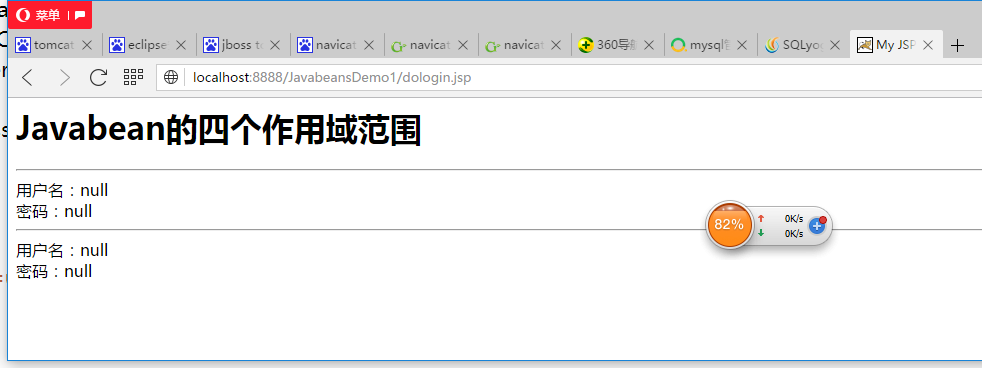
如有疑问请留言或者到本站社区交流讨论,感谢阅读,希望能帮助到大家,谢谢大家对本站的支持!


