

Java 理解 ThreadLocal
摘要:
ThreadLocal 又名线程局部变量,是 Java 中一种较为特殊的线程绑定机制,用于保证变量在不同线程间的隔离性,以方便每个线程处理自己的状态。进一步地,本文以ThreadLocal类的源码为切入点,深入分析了ThreadLocal类的作用原理,并给出应用场景和一般使用步骤。
一. 对 ThreadLocal 的理解
1). ThreadLocal 概述
ThreadLocal 又名 线程局部变量,是 Java 中一种较为特殊的 线程绑定机制,可以为每一个使用该变量的线程都提供一个变量值的副本,并且每一个线程都可以独立地改变自己的副本,而不会与其它线程的副本发生冲突。通过 ThreadLocal 存取的数据,总是与当前线程相关,也就是说,JVM 为每个运行的线程绑定了私有的本地实例存取空间,从而为多线程环境常出现的并发访问问题提供了一种 隔离机制 。
2). ThreadLocal 在 JDK 中的定义
ThreadLocal
This class provides thread-local variables. These variables differ from their normal counterparts(副本) in that each thread that accesses one (via its get or set method) has its own, independently initialized copy of the variable. ThreadLocal instances are typically private static fields in classes that wish to associate state with a thread (e.g., a user ID or Transaction ID).
Each thread holds an implicit reference to its copy of a thread-local variable (见下图) as long as the thread is alive and the ThreadLocal instance is accessible; after a thread goes away, all of its copies of thread-local instances are subject to garbage collection (unless other references to these copies exist).
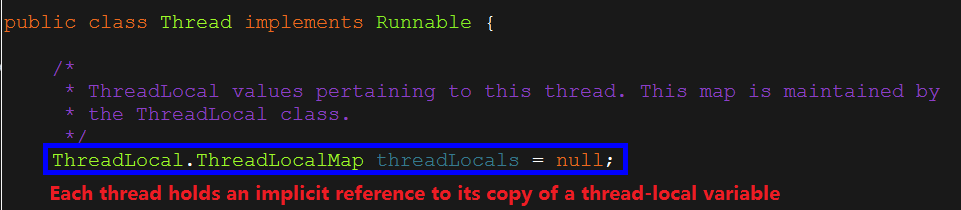
我们可以从中摘出三条要点:
每个线程都有关于该 ThreadLocal变量 的私有值
每个线程都有一个独立于其他线程的上下文来保存这个变量的值,并且对其他线程是不可见的。
独立于变量的初始值
ThreadLocal 可以给定一个初始值,这样每个线程就会获得这个初始化值的一个拷贝,并且每个线程对这个值的修改对其他线程是不可见的。
状态与某一个线程相关联
ThreadLocal 不是用于解决共享变量的问题的,也不是为了协调线程同步而存在,而是为了方便每个线程处理自己的状态而引入的一个机制,理解这点对正确使用 ThreadLocal 至关重要。
3). 应用场景
类 ThreadLocal 主要解决的就是为每个线程绑定自己的值,以方便其处理自己的状态。形象地讲,可以将 ThreadLocal变量 比喻成全局存放数据的盒子,盒子中可以存储每个线程的私有数据。例如,以下类用于生成对每个线程唯一的局部标识符。线程 ID 是在第一次调用 uniqueNum.get() 时分配的,在后续调用中不会更改。
import java.util.concurrent.atomic.AtomicInteger;

public class UniqueThreadIdGenerator {
  private static final AtomicInteger uniqueId = new AtomicInteger(0);

  private static final ThreadLocal<Integer> uniqueNum = new ThreadLocal<Integer>() {
    @Override
    protected Integer initialValue() {
      return uniqueId.getAndIncrement();
    }
  };

  public static void main(String[] args) {
    Thread[] threads = new Thread[5];
    for (int i = 0; i < 5; i++) {
      String name = "Thread-" + i;
      threads[i] = new Thread(name){
        @Override
        public void run() {
          System.out.println(Thread.currentThread().getName() + ": "
              + uniqueNum.get());
        }
      };
      threads[i].start();
    }

    System.out.println(Thread.currentThread().getName() + ": "
        + uniqueNum.get());
  }
}/* Output(输出结果不唯一):
    Thread-1: 2
    Thread-0: 0
    Thread-2: 3
    main: 1
    Thread-3: 4
    Thread-4: 5
 *///:~
二. 深入分析ThreadLocal类
下面,我们来看一下 ThreadLocal 的具体实现,该类一共提供的四个方法:
public T get() { }
public void set(T value) { }
public void remove() { }
protected T initialValue() { }
其中,get()方法是用来获取 ThreadLocal变量 在当前线程中保存的值,set() 用来设置 ThreadLocal变量 在当前线程中的值,remove() 用来移除当前线程中相关 ThreadLocal变量,initialValue() 是一个 protected 方法,一般需要重写。
1、 原理探究
1). 切入点:get()
首先,我们先看其源码:
 /**
   * Returns the value in the current thread's copy of this
   * thread-local variable. If the variable has no value for the
   * current thread, it is first initialized to the value returned
   * by an invocation of the {@link #initialValue} method.
   *
   * @return the current thread's value of this thread-local
   */
  public T get() {
    Thread t = Thread.currentThread();  // 获取当前线程对象
    ThreadLocalMap map = getMap(t);   // 获取当前线程的成员变量 threadLocals
    if (map != null) {
      // 从当前线程的 ThreadLocalMap 获取该 thread-local variable 对应的 entry
      ThreadLocalMap.Entry e = map.getEntry(this);
      if (e != null)
        return (T)e.value;  // 取得目标值
    }
    return setInitialValue();
  }
2).关键点:setInitialValue()
/**
   * Variant of set() to establish initialValue. Used instead
   * of set() in case user has overridden the set() method.
   *
   * @return the initial value
   */
  private T setInitialValue() {
    T value = initialValue();   // 默认实现返回 null
    Thread t = Thread.currentThread();  // 获得当前线程
    ThreadLocalMap map = getMap(t);   // 得到当前线程 ThreadLocalMap类型域 threadLocals
    if (map != null)
      map.set(this, value); // 该 map 的键是当前 ThreadLocal 对象
    else
      createMap(t, value);
    return value;
  }
我们紧接着看上述方法涉及到的三个方法:initialValue(),set(this, value) 和 createMap(t, value)。
(1) initialValue()
 /**
   * Returns the current thread's "initial value" for this
   * thread-local variable. This method will be invoked the first
   * time a thread accesses the variable with the {@link #get}
   * method, unless the thread previously invoked the {@link #set}
   * method, in which case the <tt>initialValue</tt> method will not
   * be invoked for the thread. Normally, this method is invoked at
   * most once per thread, but it may be invoked again in case of
   * subsequent invocations of {@link #remove} followed by {@link #get}.
   *
   * <p>This implementation simply returns <tt>null</tt>; if the
   * programmer desires thread-local variables to have an initial
   * value other than <tt>null</tt>, <tt>ThreadLocal</tt> must be
   * subclassed, and this method overridden. Typically, an
   * anonymous inner class will be used.
   *
   * @return the initial value for this thread-local
   */
  protected T initialValue() {
    return null;      // 默认实现返回 null
  }
(2) createMap()
/**
   * Create the map associated with a ThreadLocal. Overridden in
   * InheritableThreadLocal.
   *
   * @param t the current thread
   * @param firstValue value for the initial entry of the map
   * @param map the map to store.
   */
  void createMap(Thread t, T firstValue) {
    t.threadLocals = new ThreadLocalMap(this, firstValue); // this 指代当前 ThreadLocal 变量,为 map 的键
  }
至此,可能大部分朋友已经明白了 ThreadLocal类 是如何为每个线程创建变量的副本的:
① 在每个线程Thread内部有一个 ThreadLocal.ThreadLocalMap 类型的成员变量 threadLocals,这个threadLocals就是用来存储实际的ThreadLocal变量副本的,键值为当前ThreadLocal变量,value为变量的副本(值);
② 初始时,在Thread里面,threadLocals为空,当通过ThreadLocal变量调用get()方法或者set()方法,就会对Thread类中的threadLocals进行初始化,并且以当前ThreadLocal变量为键值,以ThreadLocal要保存的值为value,存到 threadLocals;
③ 然后在当前线程里面,如果要使用副本变量,就可以通过get方法在对应线程的threadLocals里面查找。
2、实例验证
下面通过一个例子来证明通过ThreadLocal能达到在每个线程中创建变量副本的效果:
public class Test {

  ThreadLocal<Long> longLocal = new ThreadLocal<Long>();
  ThreadLocal<String> stringLocal = new ThreadLocal<String>();

  public void set() {
    longLocal.set(Thread.currentThread().getId());
    stringLocal.set(Thread.currentThread().getName());
  }

  public long getLong() {
    return longLocal.get();
  }

  public String getString() {
    return stringLocal.get();
  }

  public static void main(String[] args) throws InterruptedException {
    final Test test = new Test();

    test.set();
    System.out.println("父线程 main :");
    System.out.println(test.getLong());
    System.out.println(test.getString());

    Thread thread1 = new Thread() {
      public void run() {
        test.set();
        System.out.println("\n子线程 Thread-0 :");
        System.out.println(test.getLong());
        System.out.println(test.getString());
      };
    };
    thread1.start();
  }
}/* Output:
    父线程 main :
          1
          main

    子线程 Thread-0 :
          12
          Thread-0
 *///:~
从这段代码的输出结果可以看出,在main线程中和thread1线程中,longLocal保存的副本值和stringLocal保存的副本值都不一样,并且进一步得出:
三. ThreadLocal的应用场景
在 Java 中,类 ThreadLocal 解决的是变量在不同线程间的隔离性。 最常见的 ThreadLocal 使用场景有 数据库连接问题、Session管理等。
(1) 数据库连接问题
private static ThreadLocal<Connection> connectionHolder = new ThreadLocal<Connection>() {
  public Connection initialValue() {
    return DriverManager.getConnection(DB_URL);
  }
};

public static Connection getConnection() {
  return connectionHolder.get();
}
(2) Session管理
private static final ThreadLocal threadSession = new ThreadLocal();

public static Session getSession() throws InfrastructureException {
  Session s = (Session) threadSession.get();
  try {
    if (s == null) {
      s = getSessionFactory().openSession();
      threadSession.set(s);
    }
  } catch (HibernateException ex) {
    throw new InfrastructureException(ex);
  }
  return s;
}
四. ThreadLocal 一般使用步骤
ThreadLocal 使用步骤一般分为三步:
感谢阅读,希望能帮助到大家,谢谢大家对本站的支持!


