

list是C++容器类中的“顺序存储结构”所包含的一种结构。list是非连续存储结构,具有双链表结构,支持前向/后向遍历,且支持高效的随机删除/插入。
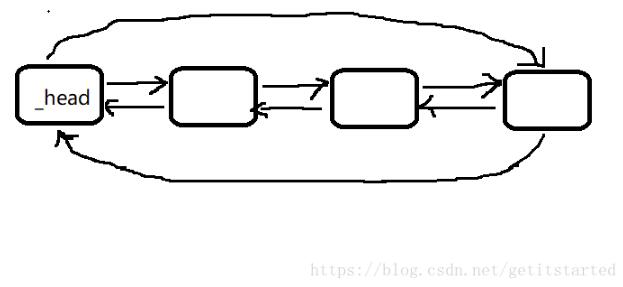
实现代码如下:
**list.h**
#pragma once

#include<stdio.h>
#include<assert.h>
#include<iostream>
using namespace std;

typedef int DataType;

struct ListNode
{
 ListNode* _next;
 ListNode* _prev;

 DataType _data;

 ListNode(DataType x)
  :_data(x)
  , _next(NULL)
  , _prev(NULL)
 {}
};
**test.cpp**
#define _CRT_SECURE_NO_WARNINGS 1

#include "list.h"

class List{
 typedef ListNode Node;
public:
 List()
  :_head(new Node(DataType())){
  _head->_next = _head;
  _head->_prev = _head;
 }

 List(const List& l)
  :_head(new Node(DataType())){
  _head->_next = _head;
  _head->_prev = _head;
  Node* cur = l._head->_next;
  while (cur!=l._head){
   PushBack(cur->_data);
   cur = cur->_next;
  }
 }

 List& operator=(const List& l){
  if (this != &l){
   //swap(_head, l._head);
  }
  return *this;
 }

 ~List(){
  Node* cur = _head->_next;
  while (cur != _head){
   Node* next= cur->_next;
   delete cur;
   cur = next;
  }
  delete _head;
  _head = NULL;
 }

 void PushBack(DataType x){
  Node* prev = _head->_prev;
  Node* new_node = new Node(x);
  prev->_next = new_node;
  new_node->_prev = prev;
  _head->_prev = new_node;
  new_node->_next = _head;
 }

 void PushFront(DataType x){//插在头结点之后
  Node* cur = _head->_next;
  Node* new_node = new Node(x);
  new_node->_next = cur;
  cur->_prev = new_node;
  new_node->_prev = _head;
  _head->_next = new_node;
 }

 void PopBack(){
  Node* delete_node = _head->_prev;
  Node* cur = delete_node->_prev;
  _head->_prev = cur;
  cur->_next = _head;
  delete delete_node;
 }

 void PopFront(){
  Node* delete_node = _head->_next;
  Node* cur = delete_node->_next;

  _head->_next = cur;
  cur->_prev = _head;
  delete delete_node;
 }

 Node* Find(DataType x){
  Node* to_find = _head->_next;
  while (to_find != _head){
   if (to_find->_data == x){
    return to_find;
   }
   to_find = to_find->_next;
  }
  return NULL;
 }

 void Insert(Node* pos, DataType x){//在pos位置前插入数据
  assert(pos);
  Node* new_node = new Node(x);
  Node* prev = pos->_prev;
  new_node->_next = pos;
  pos->_prev = new_node;
  new_node->_prev = prev;
  prev->_next = new_node;
 }

 void Erase(Node* pos){
  assert(pos);
  Node* prev = pos->_prev;
  Node* next = pos->_next;
  prev->_next = next;
  next->_prev = prev;
  delete pos;
 }

 void Print() const{
  Node* cur = _head->_next;
  cout <<" _head->";
  while (cur!= _head){
   cout << cur->_data << "->";
   cur = cur->_next;
  }
  cout << endl;
  Node* pos = _head->_prev;
  while (pos != _head){
   cout << pos->_data << "<-";
   pos = pos->_prev;
  }
  cout << "_head" << endl;
 }
private:
 Node* _head;
};

void TestList(){
 List L;
 L.PushBack(1);
 L.PushBack(2);
 L.PushBack(4);
 L.PushBack(5);
 L.PopBack();
 L.Print();

 ListNode* pos = L.Find(1);
 printf("pos->data:%d[%p]\n",pos->_data,pos);
 pos = L.Find(2);
 printf("pos->data:%d[%p]\n", pos->_data, pos);
 pos = L.Find(4);
 printf("pos->data:%d[%p]\n", pos->_data, pos);
 printf("\n");

 L.Insert(pos, 3);
 L.Print();
 L.Erase(pos);
 L.Print();
 printf("\n");

 List L1;
 L1.PushFront(4);
 L1.PushFront(3);
 L1.PushFront(2);
 L1.PushFront(1);
 L1.Print();
 L1.PopFront();
 L1.Print();

}

int main(){
 TestList();
 return 0;
}
以上就是本文的全部内容,希望对大家的学习有所帮助,也希望大家多多支持脚本之家。


