

本文实例为大家分享了C++类实现线性表的具体代码,供大家参考,具体内容如下
下图是标准C语言实现的函数定义
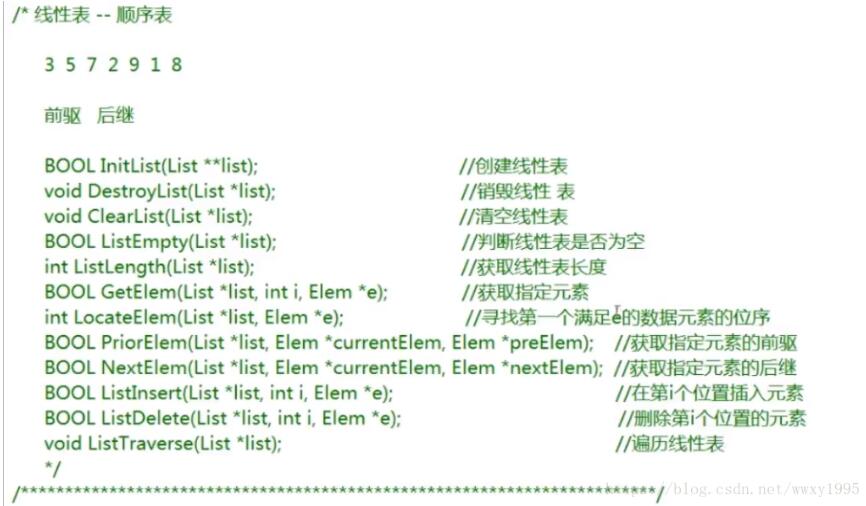
下面可以用C++实现,第一个参数就是this的指针
list.h函数
#pragma once
typedef int Elem;
class List
{
public:
 List(int size);
 ~List();
 void ClearList();                  // 将数组长度设为0
 bool ListEmpty();                  // 判断数组是否为空
 int ListLength();                  // 获取数组长度
 bool GetElem(int i, Elem *e);            // 查找指定下标元素
 int LocateElem(Elem *e);              // 查找指定元素
 bool PriorElem(Elem *currentElem, Elem *preElem);  // 查找元素的前驱元素
 bool NextElem(Elem *currentElem, Elem *nextElem);  // 查找元素的后继元素
 void ListTraverse();                // 遍历线性表,输出元素
 bool ListInsert(int i, Elem *e);          // 在指定位置插入一个元素
 bool ListDelete(int i, Elem *e);          // 删除指定位置元素
private:
 int *m_pList;                    // 指向一块内存
 int m_iSize;                    // 内存的大小
 int m_iLength;                   // 数组的长度
};
类的实现,list.cpp
#include<iostream>
#include "List.h"
using namespace std;

List::List(int size)
{
 m_iSize = size;
 m_pList = new Elem[m_iSize];
 m_iLength = 0;
}


List::~List()
{
 delete[] m_pList; // 释放数组内存
 m_pList = NULL;
}

void List::ClearList()
{
 m_iLength = 0;
}

bool List::ListEmpty()
{
 return m_iLength == 0 ? true : false;
}

int List::ListLength()
{
 return m_iLength;
}

bool List::GetElem(int i, Elem *e)
{
 if (i < 0 || i >= m_iSize)
 {
 return false;
 }
 *e = m_pList[i];
 return true;
}

int List::LocateElem(Elem *e)
{
 for (int i = 0; i < m_iLength; i++)
 {
 if (m_pList[i] == *e)
 {
  return i;
 }
 }
 return -1;
}

bool List::PriorElem(Elem *currentElem, Elem *preElem)
{
 int temp = LocateElem(currentElem); // 查找元素的序号
 if (temp == -1)
 return false;
 else if (temp == 0)
 return false;
 else
 {
 *preElem = m_pList[temp - 1];
 return true;
 }

}

bool List::NextElem(Elem *currentElem, Elem *nextElem)
{
 int temp = LocateElem(currentElem); // 查找元素的序号
 if (temp == -1)
 return false;
 else if (temp == m_iLength - 1)
 return false;
 else
 {
 *nextElem = m_pList[temp + 1];
 return true;
 }
}

void List::ListTraverse()
{
 for (int i = 0; i < m_iLength; i++)
 {
 cout << m_pList[i] << endl;
 }
}

bool List::ListInsert(int i, Elem *e)
{
 if (i<0 || i>m_iLength)
 return false;
 for (int k=m_iLength-1;k>=i;k--)
 {
 m_pList[k + 1] = m_pList[k];
 }
 m_pList[i] = *e;
 m_iLength++;
 return true;
}

bool List::ListDelete(int i, Elem *e)
{
 if (i<0 || i>m_iLength)
 return false;
 *e = m_pList[i];
 for (int k = i + 1; k < m_iLength; k++)
 {
 m_pList[k - 1] = m_pList[k];
 }
 m_iLength--;
 return true;
}
测试主程序
#include<iostream>
#include "List.h"
using namespace std;

int main()
{
 Elem temp;
 Elem arry[11] = { 3,5,7,2,9,1,8 };
 List *list1 = new List(10);
 cout << "length:" << list1->ListLength() << endl;
 for (int i = 0; i < 7; i++)
 {
 list1->ListInsert(i, &arry[i]);
 }
 cout << "length:" << list1->ListLength() << endl;
 // 删除第一个元素
 list1->ListDelete(0, &temp);
 cout << temp << endl;
 // 搜索前驱元素
 list1->PriorElem(&arry[4], &temp);
 cout << temp << endl;
 list1->NextElem(&arry[4], &temp);
 cout << temp << endl;
 list1->ListTraverse();
 delete list1;
  return 0;
}
以上就是本文的全部内容,希望对大家的学习有所帮助,也希望大家多多支持脚本之家。


