

介绍
本程序是根据广度优先遍历算法的思想设计的一款迷宫游戏,游戏设计了两种模式一种自动游戏模式,一种手动模式。因为项目在 Linux 开发,需要在 Windows 开发的,请查看源代码中需要修改地方的备注。
截图
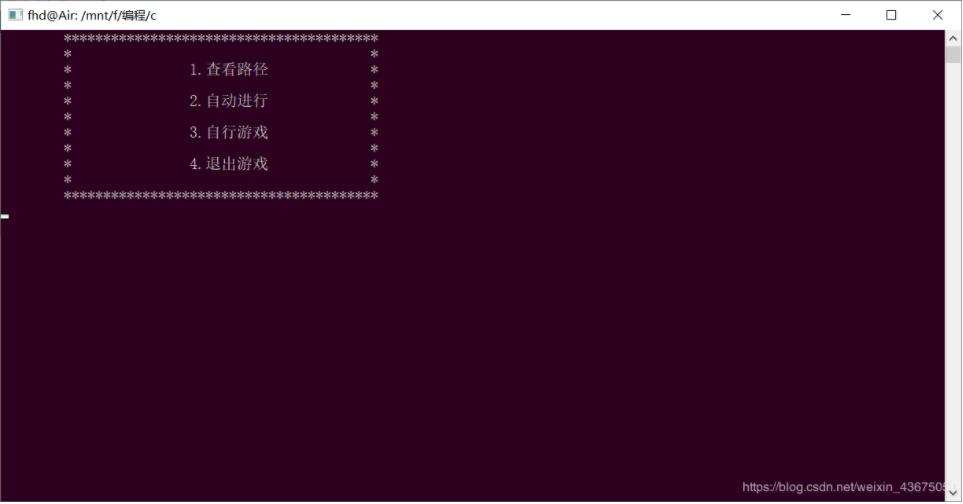
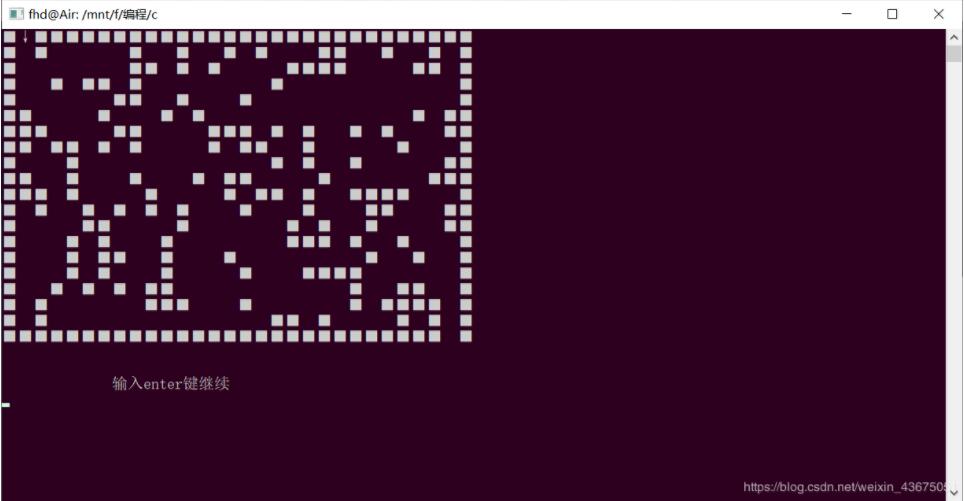
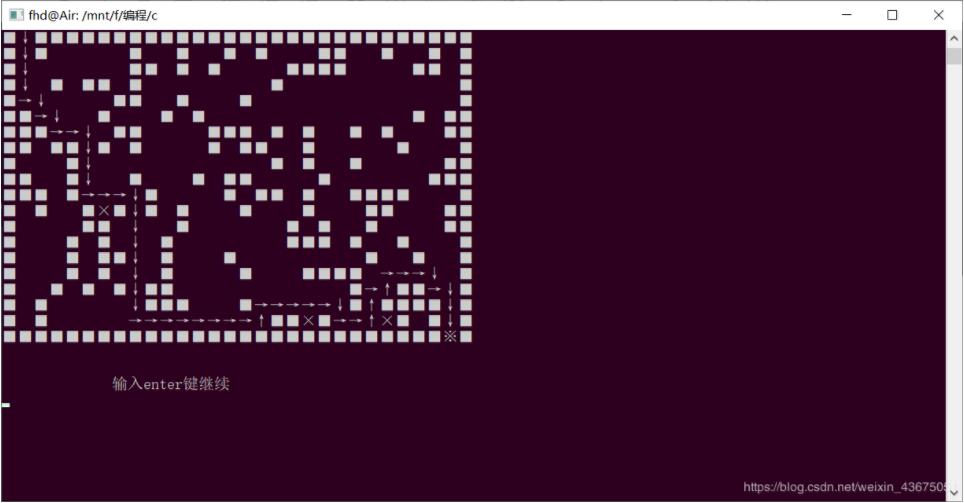
代码
#include <iostream>
#include <cstdlib> //标准库
#include <unistd.h> //延时函数
#include <stdio.h> //getchar
#include <ctime>
#include <termios.h> //终端设置

#define MAX_X 20
#define MAX_Y 30
bool flag = false;
bool slow = false;
bool autogame = true;

using namespace std;

int maze[MAX_X][MAX_Y]; //迷宫

//路线栈
class stack_of_maze{
private:
 //记录迷宫坐标
 struct node
 {
 int x;
 int y;
 char direction; //上一步路径(如何来的)
 node* next;
 };
 node* head;
public:
 stack_of_maze(){
 head = NULL;
 }

 ~stack_of_maze(){
 node* p = head;
 while(head!=NULL){
 head = head->next;
 delete p;
 p = head;
 }
 }

 //压栈
 void push(int xx,int yy,char ddirection){
 node* new_node = new node;
 if(new_node!=NULL){
 new_node->x = xx;
 new_node->y = yy;
 new_node->direction = ddirection;
 new_node->next = NULL;

 if(head==NULL)
 head = new_node;
 else{
 new_node->next = head;
 head = new_node;
 }
 }
 else
 cout<<"内存分配失败"<<endl;

 }

 //出栈
 node* pop(int& xx,int& yy){
 if(head!=NULL){
 node* p = head;
 head = head->next;
 xx = p->x;
 yy = p->y;
 delete p;
 }
 return head;
 }

 void print(){
 if(head!=NULL){
 node* p = head;
 while(p!=NULL){
 cout<<" "<<p->x<<" "<<p->y<<" "<<p->direction<<endl;
 p = p->next;
 }
 }
 else
 cout<<"栈为空,打印失败"<<endl;
 }
};

//创建迷宫
void createMaze(){
 int maxway = MAX_X * MAX_Y; //最大通路
 int x,y;

 for(x=0;x<MAX_X;x++)
 for(y=0;y<MAX_Y;y++)
 maze[x][y] = 1; //先填充迷宫

 srand((unsigned)time(NULL)); //随机函数种子,以时间为参数
 for(int i=0;i<maxway;i++) //随机构建迷宫通路
 {
 x = rand() % (MAX_X-2) + 1;
 y = rand() % (MAX_Y-2) + 1;
 maze[x][y] = 0;
 }

 maze[1][1] = 0;  //入口
 maze[MAX_X-2][MAX_Y-2] = 0; //出口

 maze[0][1] = 3;
 maze[MAX_X-1][MAX_Y-2] = 0;
}

//输出迷宫
void printMaze(){
 int x,y;
 system("clear"); //windows下使用system("cls")
 //cout<<endl;
 for(x=0;x<MAX_X;x++)
 {
 for(y=0;y<MAX_Y;y++)
 {
 if(maze[x][y]==0){cout<<" ";continue;} //通路
 if(maze[x][y]==1){cout<<"■";continue;} //墙
 if(maze[x][y]==2){cout<<"×";continue;} //死胡同
 if(maze[x][y]==3){cout<<"↓";continue;} //向下走
 if(maze[x][y]==4){cout<<"→";continue;}
 if(maze[x][y]==5){cout<<"←";continue;}
 if(maze[x][y]==6){cout<<"↑";continue;}
 if(maze[x][y]==7){cout<<"※";continue;} //当前站立位置
 }
 cout<<endl;
 }
 if(slow){
 sleep(1);   //延时函数
 }
}

void check(stack_of_maze &s){
 int temp[MAX_X][MAX_Y];

 for(int x=0;x<MAX_X;x++)
 for(int y=0;y<MAX_Y;y++)
 temp[x][y] = maze[x][y];

 int x=1,y=1;  //出发点
 while(1){
 temp[x][y] = 2;

 //向下
 if(temp[x+1][y]==0){
 s.push(x,y,'D');
 temp[x][y] = 3; //在当前位置做一个向下的标志
 x = x + 1;
 temp[x][y] = 7; //当前位置
 if((x==MAX_X-1)&&(y==MAX_Y-2)){
 flag = true;
 return;
 }
 else
 continue;
 }

 //向右
 if(temp[x][y+1]==0){
 s.push(x,y,'R');
 temp[x][y] = 4; //在当前位置做一个向右的标志
 y = y + 1;
 temp[x][y] = 7;
 if((x==MAX_X-1)&&(y==MAX_Y-2)){
 flag = true;
 return;
 }
 else
 continue;
 }

 //向上
 if(temp[x-1][y]==0){
 s.push(x,y,'U');
 temp[x][y] = 6; //在当前位置做一个向上的标志
 x = x - 1;
 temp[x][y] = 7;
 if((x==MAX_X-1)&&(y==MAX_Y-2)){
 flag = true;
 return;
 }
 else
 continue;
 }

 //向左
 if(temp[x][y-1]==0){
 s.push(x,y,'L');
 temp[x][y] = 5; //在当前位置做一个向右的标志
 y = y - 1;
 temp[x][y] = 7;
 if((x==MAX_X-1)&&(y==MAX_Y-2)){
 flag = true;
 return;
 }
 else
 continue;
 }

 //上下左右不通,则回退
 if(s.pop(x,y)==NULL && temp[x-1][y]!=0 && temp[x][y-1]!=0 && temp[x][y+1]!=0 && temp[x+1][y]!=0){
 temp[0][1] = 7;
 if(temp[1][1]!=1)
 temp[1][1] = 2;
 return;
 }
 }
}

//输入,windows下可以使用#incldue<conio.h>替代此函数
char getch(){
 char ch;
 static struct termios oldt, newt; //保存原有终端属性和新设置的终端属性
 tcgetattr( STDIN_FILENO, &oldt); //获得终端原有属性并保存在结构体oldflag

 //设置新的终端属性
 newt = oldt;
 newt.c_lflag &= ~(ICANON);
 tcsetattr( STDIN_FILENO, TCSANOW, &newt);

 //取消回显
 system("stty -echo");
 ch = getchar();
 system("stty echo");

 tcsetattr( STDIN_FILENO, TCSANOW, &oldt); //让终端恢复为原有的属性
 return ch;
}

void move(){
 int x=1,y=1;  //出发点
 while(1){
 switch(getch()){
 case 's':
 if(maze[x+1][y]==0){
  maze[x][y] = 0;
  x = x + 1;
  maze[x][y] = 7; //当前位置
  printMaze();
  if((x==MAX_X-1)&&(y==MAX_Y-2)){
  cout<<"\n\n    成功走出"<<endl;
  return;
  }
 }
 break;
 case 'd':
 if(maze[x][y+1]==0){
  if(maze[x][y+1]==0){
  maze[x][y] = 0;
  y = y + 1;
  maze[x][y] = 7;
  printMaze();
  if((x==MAX_X-1)&&(y==MAX_Y-2)){
  cout<<"\n\n    成功走出"<<endl;
  return;
  }
  }
 }

 break;
 case 'w':
 if(maze[x-1][y]==0){
  maze[x][y] = 0;
  x = x - 1;
  maze[x][y] = 7;
  printMaze();
  if((x==MAX_X-1)&&(y==MAX_Y-2)){
  cout<<"\n\n    成功走出"<<endl;
  return;
  }
 }
 break;
 case 'a':
 if(maze[x][y-1]==0){
  maze[x][y] = 0;
  y = y - 1;
  maze[x][y] = 7;
  printMaze();
  if((x==MAX_X-1)&&(y==MAX_Y-2)){
  cout<<"\n\n    成功走出"<<endl;
  return;
  }
 }
 break;
 }
 }
}

void autoMove(stack_of_maze &s){
 int x=1,y=1;  //出发点
 while(1){
 maze[x][y] = 2;

 //向下
 if(maze[x+1][y]==0){
 s.push(x,y,'D');
 maze[x][y] = 3; //在当前位置做一个向下的标志
 x = x + 1;
 maze[x][y] = 7; //当前位置
 if(slow)
 printMaze();
 if((x==MAX_X-1)&&(y==MAX_Y-2)){
 s.push(x,y,'*');
 cout<<"\n\n    成功走出"<<endl;
 return;
 }
 else
 continue;
 }

 //向右
 if(maze[x][y+1]==0){
 s.push(x,y,'R');
 maze[x][y] = 4; //在当前位置做一个向右的标志
 y = y + 1;
 maze[x][y] = 7;
 if(slow)
 printMaze();
 if((x==MAX_X-1)&&(y==MAX_Y-2)){
 s.push(x,y,'*');
 cout<<"\n\n    成功走出"<<endl;
 return;
 }
 else
 continue;
 }

 //向上
 if(maze[x-1][y]==0){
 s.push(x,y,'U');
 maze[x][y] = 6; //在当前位置做一个向上的标志
 x = x - 1;
 maze[x][y] = 7;
 if(slow)
 printMaze();
 if((x==MAX_X-1)&&(y==MAX_Y-2)){
 s.push(x,y,'*');
 cout<<"\n\n    成功走出"<<endl;
 return;
 }
 else
 continue;
 }

 //向左
 if(maze[x][y-1]==0){
 s.push(x,y,'L');
 maze[x][y] = 5; //在当前位置做一个向右的标志
 y = y - 1;
 maze[x][y] = 7;
 if(slow)
 printMaze();
 if((x==MAX_X-1)&&(y==MAX_Y-2)){
 s.push(x,y,'*');
 cout<<"\n\n    成功走出"<<endl;
 return;
 }
 else
 continue;
 }

 //上下左右不通,则回退
 if(s.pop(x,y)==NULL && maze[x-1][y]!=0 && maze[x][y-1]!=0 && maze[x][y+1]!=0 && maze[x+1][y]!=0){
 cout<<"\n\n    没有找到合适的路径"<<endl;
 maze[0][1] = 7;
 if(maze[1][1]!=1)
 maze[1][1] = 2;
 return;
 }
 }
}

void menu();

void gamestart(){
 flag = false;
 while(!flag){
 stack_of_maze stack; //定义一个栈的对象,用来记录行走路线
 createMaze();
 check(stack);
 system("clear");
 cout<<"\t*    loading.    *"<<endl;
 system("clear");
 cout<<"\t*    loading..    *"<<endl;
 system("clear");
 cout<<"\t*    loading...   *"<<endl;
 }
 printMaze();  //输出当前迷宫的初始状态
 cout<<"\n\n    输入enter键继续"<<endl;
 getchar();
 if(!autogame){
 move();
 cout<<"\n\n    输入enter键继续"<<endl;
 getchar();
 menu();
 }
 else{
 stack_of_maze stack1;
 autoMove(stack1);  //行走中……
 }
 printMaze();  //输出迷宫的最终状态
 cout<<"\n\n    输入enter键继续"<<endl;
 getchar();
 menu();
}

void menu(){
 system("clear");
 int num;
 cout<<"\t****************************************"<<endl;
 cout<<"\t*          *"<<endl;
 cout<<"\t*    1.查看路径    *"<<endl;
 cout<<"\t*          *"<<endl;
 cout<<"\t*    2.自动进行    *"<<endl;
 cout<<"\t*          *"<<endl;
 cout<<"\t*    3.自行游戏    *"<<endl;
 cout<<"\t*          *"<<endl;
 cout<<"\t*    4.退出游戏    *"<<endl;
 cout<<"\t*          *"<<endl;
 cout<<"\t****************************************"<<endl;
 slow = false;
 switch(getch()){
 case '1':
 autogame = true;
 gamestart();break;
 case '2':
 autogame = true;
 slow = true;
 gamestart();
 break;
 case '3':
 autogame = false;
 gamestart();
 break;
 case '4':
 exit(1);break;
 default:
 cout<<"\n\n    错误操作,输入enter返回!"<<endl;
 getchar();
 menu();
 }
 getchar();
}

int main(int argc,char** argv){
 menu();
 return 0;
}
以上就是本文的全部内容,希望对大家的学习有所帮助,也希望大家多多支持脚本之家。


