C#学习基础概念二十五问续2第1/2页

所属分类: 软件编程 / C#教程 阅读数: 174
收藏 0 赞 0 分享
6.sealed 修饰符是干什么的?
答:
sealed 修饰符表示密封
用于类时,表示该类不能再被继承,不能和 abstract 同时使用,因为这两个修饰符在含义上互相排斥
用于方法和属性时,表示该方法或属性不能再被继承,必须和 override 关键字一起使用,因为使用 sealed 修饰符的方法或属性肯定是基类中相应的虚成员
通常用于实现第三方类库时不想被客户端继承,或用于没有必要再继承的类以防止滥用继承造成层次结构体系混乱
恰当的利用 sealed 修饰符也可以提高一定的运行效率,因为不用考虑继承类会重写该成员
示例:
using System;
using System.Collections.Generic;
using System.Text;
namespace Example06
{
    class Program
    {
        class A
        {
            public virtual void F()
            {
                Console.WriteLine("A.F");
            }
            public virtual void G()
            {
                Console.WriteLine("A.G");
            }
        }
        class B : A
        {
            public sealed override void F()
            {
                Console.WriteLine("B.F");
            }
            public override void G()
            {
                Console.WriteLine("B.G");
            }
        }
        class C : B
        {
            public override void G()
            {
                Console.WriteLine("C.G");
            }
        }
        static void Main(string[] args)
        {
            new A().F();
            new A().G();
            new B().F();
            new B().G();
            new C().F();
            new C().G();
            Console.ReadLine();
        }
    }
}
结果:
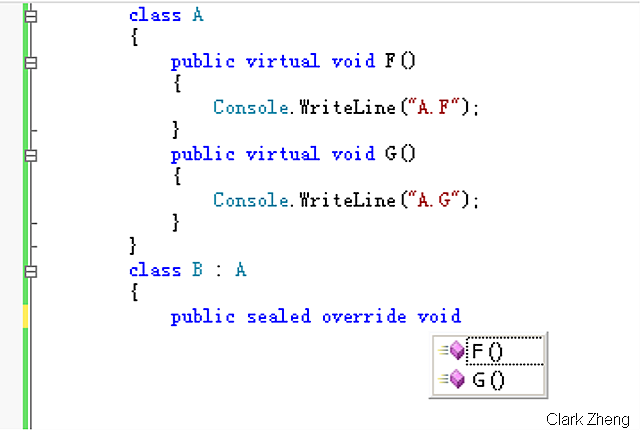
类 B 在继承类 A 时可以重写两个虚函数,如图所示:

由于类 B 中对 F 方法进行了密封, 类 C 在继承类 B 时只能重写一个函数,如图所示:
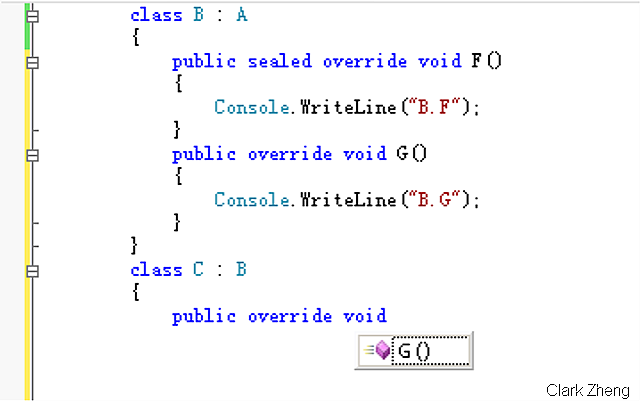
 
控制台输出结果,类 C 的方法 F 只能是输出 类B 中对该方法的实现:
A.F
A.G
B.F
B.G
B.F
C.G 

7.override 和 overload 的区别?
答:
override 表示重写,用于继承类对基类中虚成员的实现
overload 表示重载,用于同一个类中同名方法不同参数(包括类型不同或个数不同)的实现
示例:
using System;
using System.Collections.Generic;
using System.Text;
namespace Example07
{
    class Program
    {
        class BaseClass
        {
            public virtual void F()
            {
                Console.WriteLine("BaseClass.F");
            }
        }
        class DeriveClass : BaseClass
        {
            public override void F()
            {
                base.F();
                Console.WriteLine("DeriveClass.F");
            }
            public void Add(int Left, int Right)
            {
                Console.WriteLine("Add for Int: {0}", Left + Right);
            }
            public void Add(double Left, double Right)
            {
                Console.WriteLine("Add for int: {0}", Left + Right);
            }
        }
        static void Main(string[] args)
        {
            DeriveClass tmpObj = new DeriveClass();
            tmpObj.F();
            tmpObj.Add(1, 2);
            tmpObj.Add(1.1, 2.2);
            Console.ReadLine();
        }
    }
}
结果:
BaseClass.F
DeriveClass.F
Add for Int: 3
Add for int: 3.3 

8.什么是索引指示器?
答:
实现索引指示器(indexer)的类可以象数组那样使用其实例后的对象,但与数组不同的是索引指示器的参数类型不仅限于int
简单来说,其本质就是一个含参数属性
示例: 

using System;
using System.Collections.Generic;
using System.Text;
namespace Example08
{
    public class Point
    {
        private double x, y;
        public Point(double X, double Y)
        {
            x = X;
            y = Y;
        }
        //重写ToString方法方便输出
        public override string ToString()
        {
            return String.Format("X: {0} , Y: {1}", x, y);
        }
    }
    public class Points
    {
        Point[] points;
        public Points(Point[] Points)
        {
            points = Points;
        }
        public int PointNumber
        {
            get 
            { 
                return points.Length; 
            }
        }    
        //实现索引访问器
        public Point this[int Index]
        {
            get
            {
                return points[Index];
            }
        }
    }
    //感谢watson hua(http://huazhihao.cnblogs.com/)的指点
    //索引指示器的实质是含参属性,参数并不只限于int
    class WeatherOfWeek
    {
        public string this[int Index]
        {
            get
            {
                //注意case段使用return直接返回所以不需要break
                switch (Index)
                {
                    case 0:
                        {
                            return "Today is cloudy!";
                        }
                    case 5:
                        {
                            return "Today is thundershower!";
                        }
                    default:
                        {
                            return "Today is fine!";
                        }
                }
            }
        }
        public string this[string Day]
        {
            get
            {
                string TodayWeather = null;
                //switch的标准写法
                switch (Day)
                {
                    case "Sunday":
                        {
                            TodayWeather = "Today is cloudy!";
                            break;
                        }
                    case "Friday":
                        {
                            TodayWeather = "Today is thundershower!";
                            break;
                        }
                    default:
                        {
                            TodayWeather = "Today is fine!";
                            break;
                        }
                }
                return TodayWeather;
            }
        }
    }
    class Program
    {
        static void Main(string[] args)
        {
            Point[] tmpPoints = new Point[10];
            for (int i = 0; i < tmpPoints.Length; i++)
            {
                tmpPoints[i] = new Point(i, Math.Sin(i));
            }
            Points tmpObj = new Points(tmpPoints);
            for (int i = 0; i < tmpObj.PointNumber; i++)
            {
                Console.WriteLine(tmpObj[i]);
            }

            string[] Week = new string[] { "Sunday", "Monday", "Tuesday", "Wednesday", "Thursday", "Friday", "Staurday"};
            WeatherOfWeek tmpWeatherOfWeek = new WeatherOfWeek();
            for (int i = 0; i < 6; i++)
            {
                Console.WriteLine(tmpWeatherOfWeek[i]);
            }
            foreach (string tmpDay in Week)
            {
                Console.WriteLine(tmpWeatherOfWeek[tmpDay]);
            }
            Console.ReadLine();
        }
    }
}
结果:
X: 0 , Y: 0
X: 1 , Y: 0.841470984807897
X: 2 , Y: 0.909297426825682
X: 3 , Y: 0.141120008059867
X: 4 , Y: -0.756802495307928
X: 5 , Y: -0.958924274663138
X: 6 , Y: -0.279415498198926
X: 7 , Y: 0.656986598718789
X: 8 , Y: 0.989358246623382
X: 9 , Y: 0.412118485241757
Today is cloudy!
Today is fine!
Today is fine!
Today is fine!
Today is fine!
Today is thundershower!
Today is cloudy!
Today is fine!
Today is fine!
Today is fine!
Today is fine!
Today is thundershower!
Today is fine!

更多精彩内容其他人还在看

C# 大小写转换(金额)实例代码

C# 大小写转换(金额)实例代码,需要的朋友可以参考一下
收藏 0 赞 0 分享

C# WinForm中Panel实现用鼠标操作滚动条的实例方法

由于在WinForm中Panel不能直接响应鼠标的滚动事件,只好采用捕获窗体的滚动事件。
收藏 0 赞 0 分享

C#访问应用程序配置文件的方法

C#访问应用程序配置文件的方法,需要的朋友可以参考一下
收藏 0 赞 0 分享

C#读写文件的方法汇总

C#读写文件的方法汇总,需要的朋友可以参考一下
收藏 0 赞 0 分享

C#计算代码执行时间的方法

在一些测试工作时我们需要获得高精度的代码执行时间以比较其效率。
收藏 0 赞 0 分享

C# 动画窗体(AnimateWindow)的小例子

C# 动画窗体(AnimateWindow)的小例子,需要的朋友可以参考一下
收藏 0 赞 0 分享

C# zxing二维码写入的实例代码

C# zxing二维码写入的实例代码,需要的朋友可以参考一下
收藏 0 赞 0 分享

c#判断输入的是不是数字的小例子

c#判断输入的是不是数字的小例子,需要的朋友可以参考一下
收藏 0 赞 0 分享

c# 深拷贝与浅拷贝的区别分析及实例

浅拷贝(影子克隆):只复制对象的基本类型,对象类型,仍属于原来的引用. 深拷贝(深度克隆):不紧复制对象的基本类,同时也复制原对象中的对象.就是说完全是新对象产生的.
收藏 0 赞 0 分享

C#利用com操作excel释放进程的解决方法

最近利用Microsoft.Office.Interop.Excel.Application读取一个excel后,进程中一直存在excel,在网上找了一阵子,其中有几个解决方案
收藏 0 赞 0 分享
查看更多